


by: SEO Strategist
Ashot Nanayan
Updated January 16, 2026
8 min. read

WhatsApp
 (+1) 818 355 1889
WhatsApp
(+1) 818 355 1889
WhatsApp
(+1) 818 355 1889
WhatsApp
(+1) 818 355 1889
WhatsApp
(+1) 818 355 1889
You wouldn’t believe how many business owners, “SEO experts,” and agencies are wasting time on things that have nothing to do with real SEO. Honestly, I don’t always blame them.
When you Google “top SEO mistakes,” you see big publishers from well-known companies telling you to “optimize your meta tags” or “increase your DR.”
Because they rank at the top, everyone assumes that’s what matters, and it completely changes how people think about SEO.
In this guide, I’m going to walk you through the SEO mistakes you should drop immediately. If there’s at least a bit of justice left in the search results, I hope this guide will rank somewhere (I’ll happily take Bing) and help a few people avoid the mistakes that took me years to unlearn.
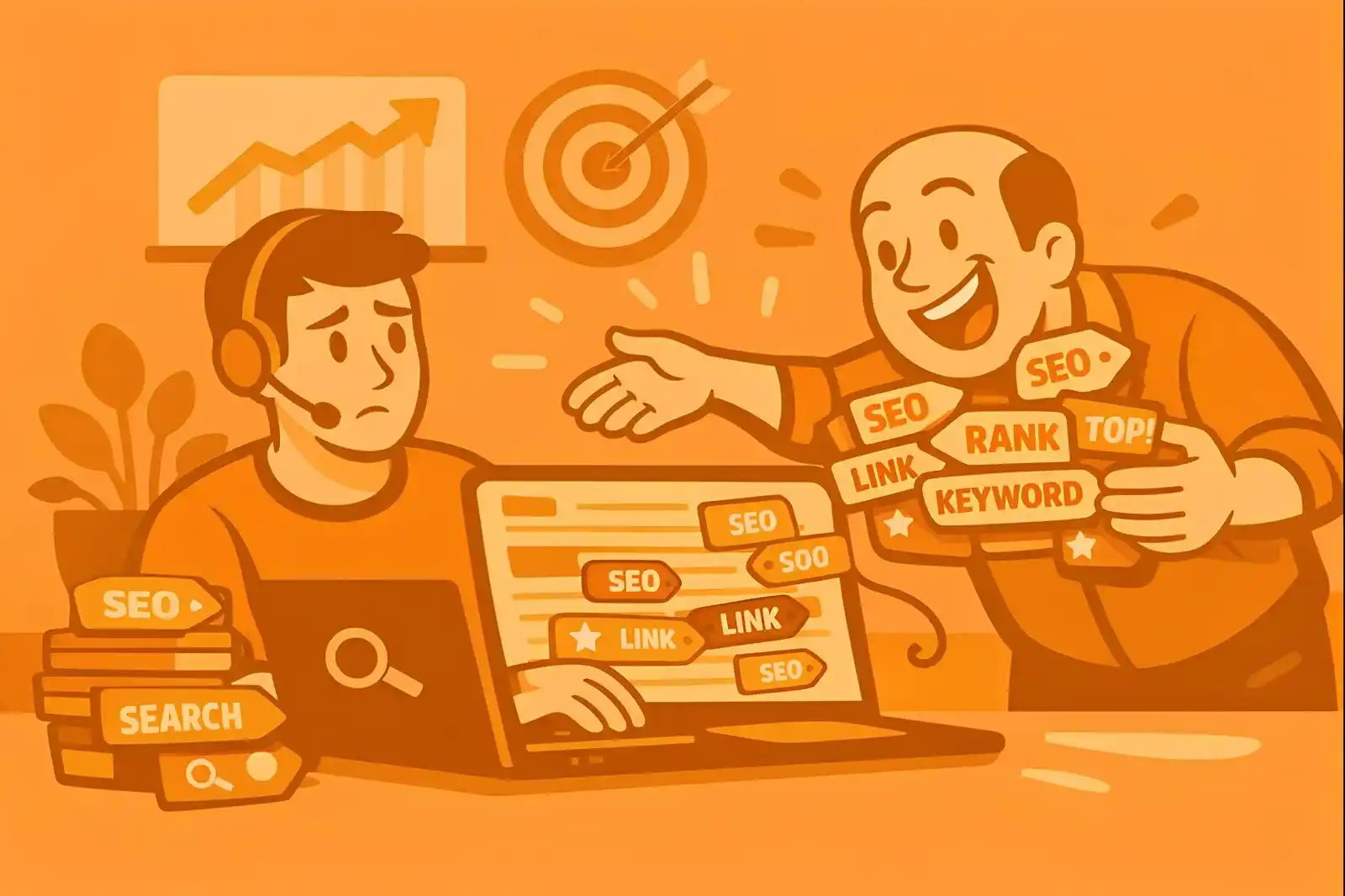
Gone are the days when you could appear at the top of Google just because you used your main keyword a few more times than your competitors. Back then, people were stuffing primary and secondary keywords everywhere with zero direction, and somehow it worked.
Today, between AI overviews, smarter PageRank signals, tools like ChatGPT, and a completely different way search engines understand context, Google is not counting how many times you wrote “best SEO agency in X city.” It’s looking at the bigger picture.
Oh man, if your “strategy” is still adding five secondary keywords into a 100-word category description, you’re not doing SEO.
Don’t repeat this mistake, please.
Stop measuring keyword density with unknown tools (That’s a scam).
Start with the user, not the keyword density. Figure out what problems they’re trying to solve, what products or services they’re looking for, and then create something useful around that.
Yes, research topics and demand. Yes, understand search intent. But your main job is not to add keywords in every paragraph; it’s to make people feel, “Okay, these guys know what they’re doing.”
I have nothing personal against SurferSEO as a company. The problem is how people use it. I still see a lot of business owners asking writers and SEOs to “optimize until all the lights are green,” like that’s the main KPI.
What happens next?
Writers get squeezed. SEO consultants and agencies, just to keep the client happy (and keep the SEO retainer), start playing the Surfer game instead of doing real SEO.
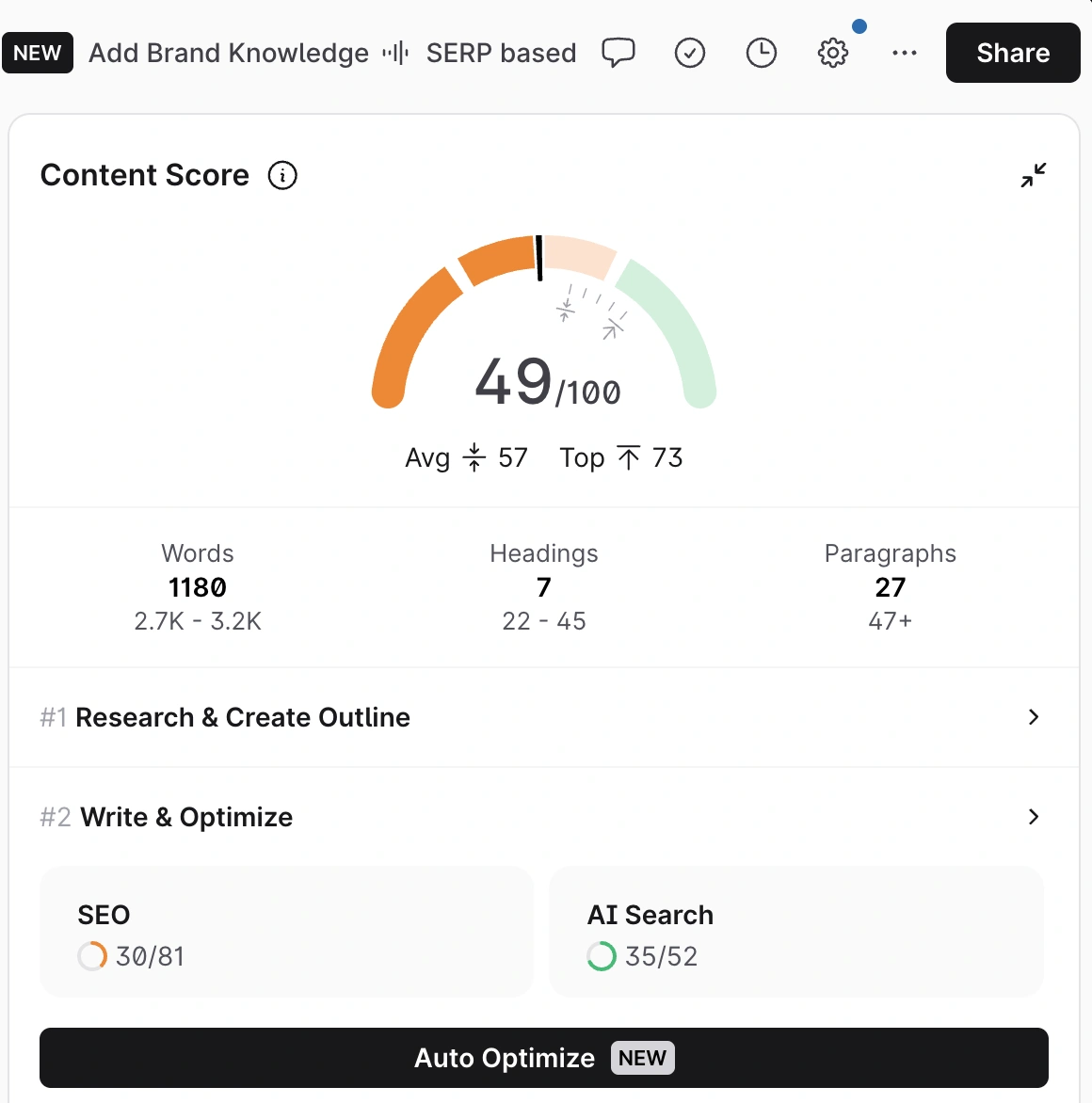
But Surfer is not Google.
It’s just a tool looking at word count, keyword usage, headings, internal/external links, and a few other signals to generate a score.
That score is not a ranking factor. Google doesn’t think like, “Nice, this guy hit the perfect keyword density Surfer suggested.”
When you blindly follow those instructions, you often craft repetitive content that looks “optimized” on a dashboard but feels dead to a real user.
If you’re doing this right now, stop making your strategy revolve around a green circle in a third-party tool.
At best, you can use Surfer (or similar tools) to find some keyword variations or discover a few extra angles/secondary topics. But you absolutely don’t need it to decide whether your content is “good enough.”
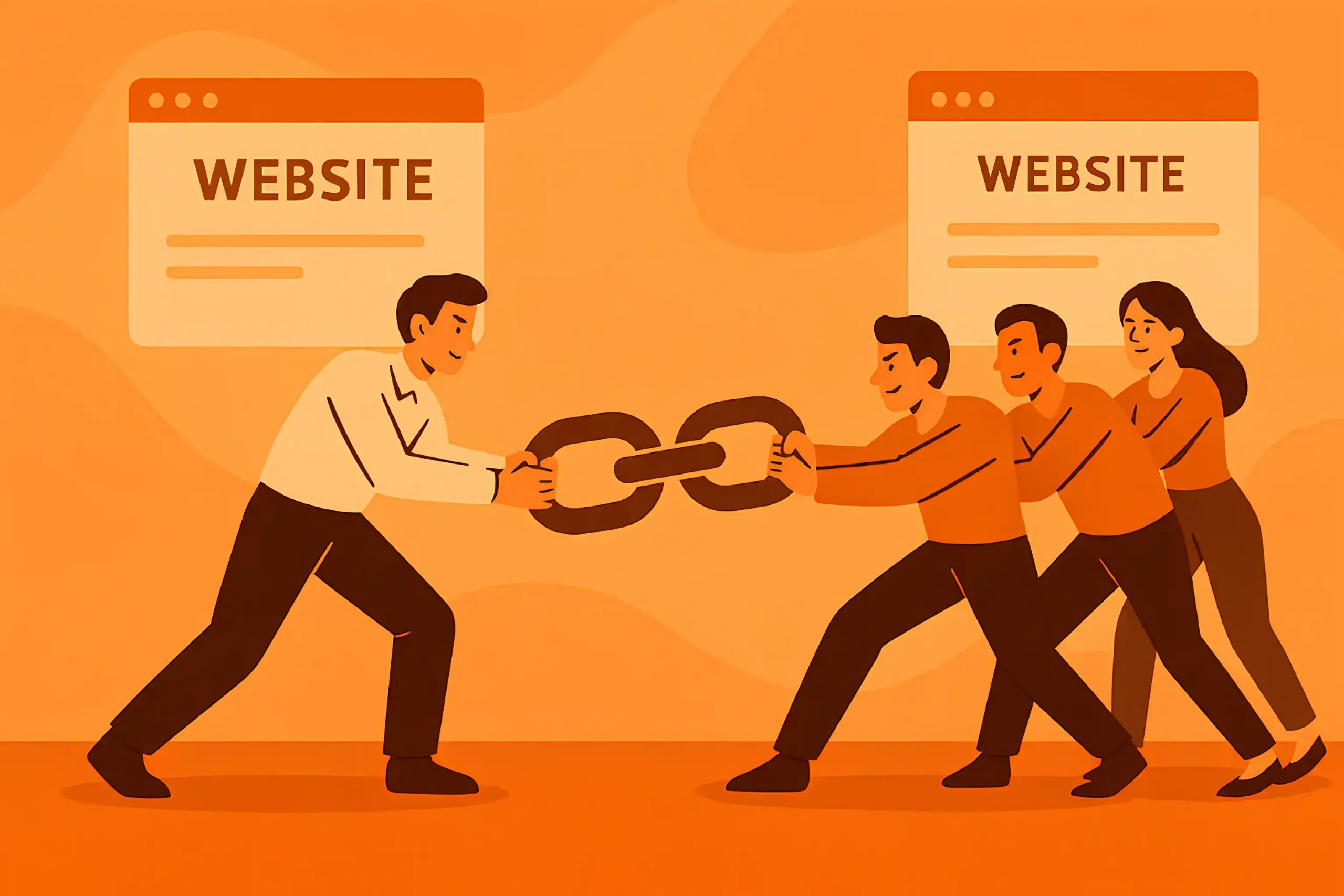
Buying backlinks or participating in link schemes is clearly against Google’s guidelines. We all know that.
But whether you like it or not, most of the industry is paying for links in one way or another, maybe because, according to statistics, 39% of link buyers perceive a 20-40% short-term lift in rankings within 30 days of acquiring paid links.
However, the real problem isn’t just “buying links.” The real problem is where those links come from.
If you’re buying backlinks from random, unrelated, spammy sites, PBNs, or obvious link farms, you’re playing a very dangerous game.
These are low-quality sites created only to sell links. No real audience, no brand, no value.
What makes it even more frustrating is that some of these sites still see results. I know there are websites and “agencies” that build massive PBN networks and, yes, sometimes they get short-term wins and even a few years of decent rankings.
I don’t believe that game will work forever.
With how fast Google is evolving, I’m pretty sure a lot of these networks will eventually get hit hard.
When they do, the sites attached to them will see those “mysterious” sudden traffic drops everyone loves to complain about.
Of course, as an SEO, I can’t sit here and pretend nobody pays for links. But if you’re going to invest in backlinks, at least stay away from PBNs and link farms.
No matter who recommends them or how cheap they are, this is one of those SEO mistakes that looks smart today and destroys you tomorrow.
Also read: Best Link-Building Techniques to Win Google’s Heart
This one really annoys me. There are millions of so-called “writers” who just rephrase competitor articles or dump whatever ChatGPT/Gemini gives them and deliver it as is. That’s a real problem.
However, there is a nuance nobody talks about.
Take this article you’re reading now. Yes, I’m using ChatGPT to write it. But I didn’t ask it, “What are the top SEO mistakes?” and copied and pasted the answer.
I brought the ideas, the experience, the stories, and the opinions. I’m using ChatGPT for SEO as a tool to structure and polish my English because I’m not a native speaker; that’s it. The thinking is mine.
Now, if you run this piece through any AI detector, chances are it will show “high probability of AI.”
Does that suddenly make everything I know about SEO fake? Of course not.
Google is not there with an AI detector deciding, “This was written with a tool, let’s penalize it.”
What Google does care about is: Is this helpful?
Does it say something meaningful, or is it just noise?
Also read: Is AI Content Good for SEO?
You have to separate “AI-assisted content” from “low-quality, generic content with zero human insight.” Those are not the same thing.
When you judge your writers only by AI detectors, you’re using the wrong filter.
These tools look for patterns, phrases, and styles, all of which can be gamed or “paraphrased away.” They can’t tell if the person actually knows what they’re talking about.
So, instead of obsessing over detection scores, do something old-school:
Read the article.
Ask: Would I trust this? Does it sound like it comes from someone who’s done the work?
If the answer is yes, it doesn’t matter if the writer used tools to speed things up, clean up grammar, or improve structure. That’s just smart.
If the answer is no, then it’s bad content, even if every AI detector says “100% human.”
So please, don’t make this mistake. Don’t judge your writers by a screenshot. Judge them by their thinking, their experience, and the value they bring.
I love following SEO news. I read the blogs, watch the videos, and see what people like Neil Patel and all the other “big names” are saying.
The problem starts when every new idea instantly becomes a “must-do” for your business.
Before you copy any SEO trend, you have to look at your own reality:
What’s your SEO budget?
What stage is your business in?
What market are you targeting?
What’s already working for you?
For example, I also had to add AI SEO services to our agency’s offer. Not because I woke up one day and felt like rebranding everything, but because people were asking for it.
Dozens of clients wanted help with AI Overviews, ChatGPT, and all that new stuff. It made sense for us.
Some trends are only relevant for huge brands. Some are good ideas, but not for you right now.
So instead of following every new tactic you see on LinkedIn or YouTube, open your analytics. Look at your current results. Where are you losing money? Where are you leaving money on the table? What are your realistic next steps for the next 3–6 months?
Use trends as input, not as orders. Listen, think, then decide. Your experience plus your data will always beat the best SEO trends.

You can’t imagine what I feel every time I get a message like: “I want higher DR”
or “ DA 50+ links only.” Or when I read an “SEO case study” where the big achievement is: “We helped the client increase their DR from 12 to 48.”
This is honestly one of the worst SEO “goals” I see in the industry.
Ahrefs DR, Moz DA, Semrush Authority Score, and Majestic TF/CF; all of these are third-party metrics. They are not Google signals. They’re just rough estimations built by tools.
Helpful sometimes as a quick reference? Sure. Real SEO KPI? Absolutely not.
You can just buy a handful of random backlinks, get listed in a bunch of low-quality directories, join some link networks, and boom, your DR or DA goes up. Does that mean you deserve more traffic, leads, or customers? No.
Stop setting KPIs like “increase DR from 20 to 40.”Stop choosing links only by DR/DA filters. Stop thinking a higher score automatically means better SEO.
Care about things that move your business, such as relevant sites in your niche, traffic, and real audiences, conversions, leads, and revenue.
I couldn’t leave this out of the list, because this mindset is getting more popular every month.
Today’s SEO is not what we did 10+ years ago. You can’t just open Ahrefs, sort by search volume, grab the biggest numbers, and build your entire strategy around that. Especially in B2B and high-ticket industries, that mindset is a straight road to frustration.
One of the biggest mistakes I see is that SEOs are trying to compete for big, highly competitive, high-volume keywords that their site has zero chance of ranking for in the next few years.
Meanwhile, they completely ignore very specific, “zero-volume” queries that their buyers are using.
Take something like SEO for oil and gas companies. You might only see a handful of “decent” volume keywords there, and they’re usually broad, generic, and insanely competitive.
But when you start thinking like your ideal client, you’ll come up with very specific searches they might use. Things like “SEO consultant for midstream oil and gas companies” or “B2B SEO for oilfield equipment manufacturers” might show no volume in tools, yet one good lead from that page can be worth tens of thousands of dollars.

If you play with tools like AnswerThePublic and just look at how people search on ChatGPT and other platforms, you’ll see something interesting. People don’t always type neat, short keywords.
They type full questions, messy prompts, and very long phrases. Many of those never appear with any measurable volume in classic keyword tools, but they reveal how people think and what they’re looking for.
Then there’s Google Search Console. If you dig into your data, you’ll often notice clicks coming from long, weird, specific queries you never “targeted.” Many of those have no visible volume in third-party tools, yet they still send you traffic and sometimes real leads.
Think about your niche. Think about your buyers. Think about the exact phrases they might write when they’re desperate to solve a problem and ready to pay someone who understands them.
Of course, there are many keyword research techniques, and you can still go after bigger keywords, but don’t build your strategy only around them. The “boring” long-tail, zero-volume stuff is often where the most qualified leads quietly come from.
I’m sure you already know what Ahrefs’ Keyword Difficulty is supposed to represent. In simple terms, it estimates how hard it is to rank for a keyword based on backlinks and the “strength” of the pages already ranking.
On paper, it sounds helpful. In reality, in most cases, it’s misleading, and building a strategy only around KD is a big mistake.
For example, the keyword “ Common SEO mistakes to avoid ” has a low KD, according to Ahrefs.
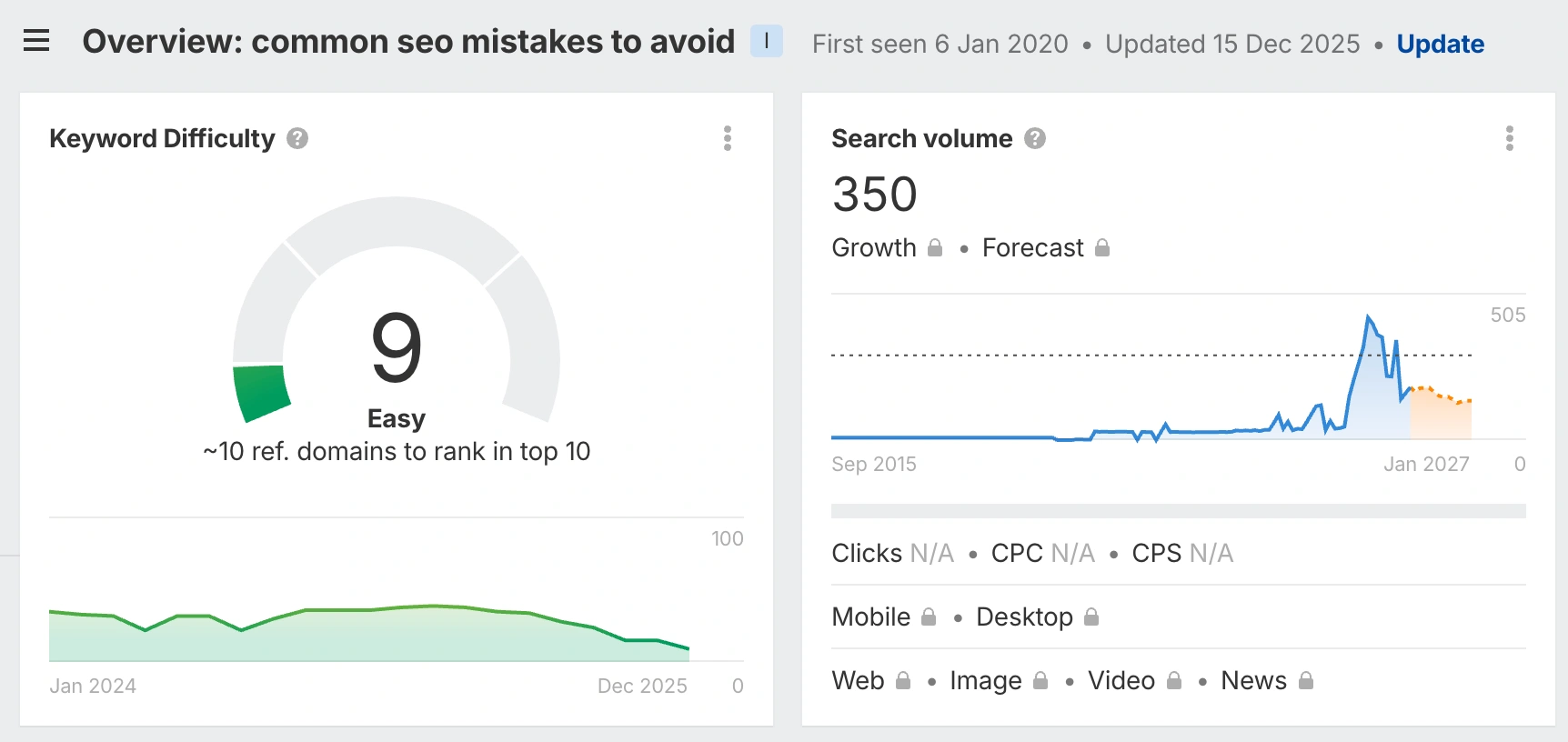
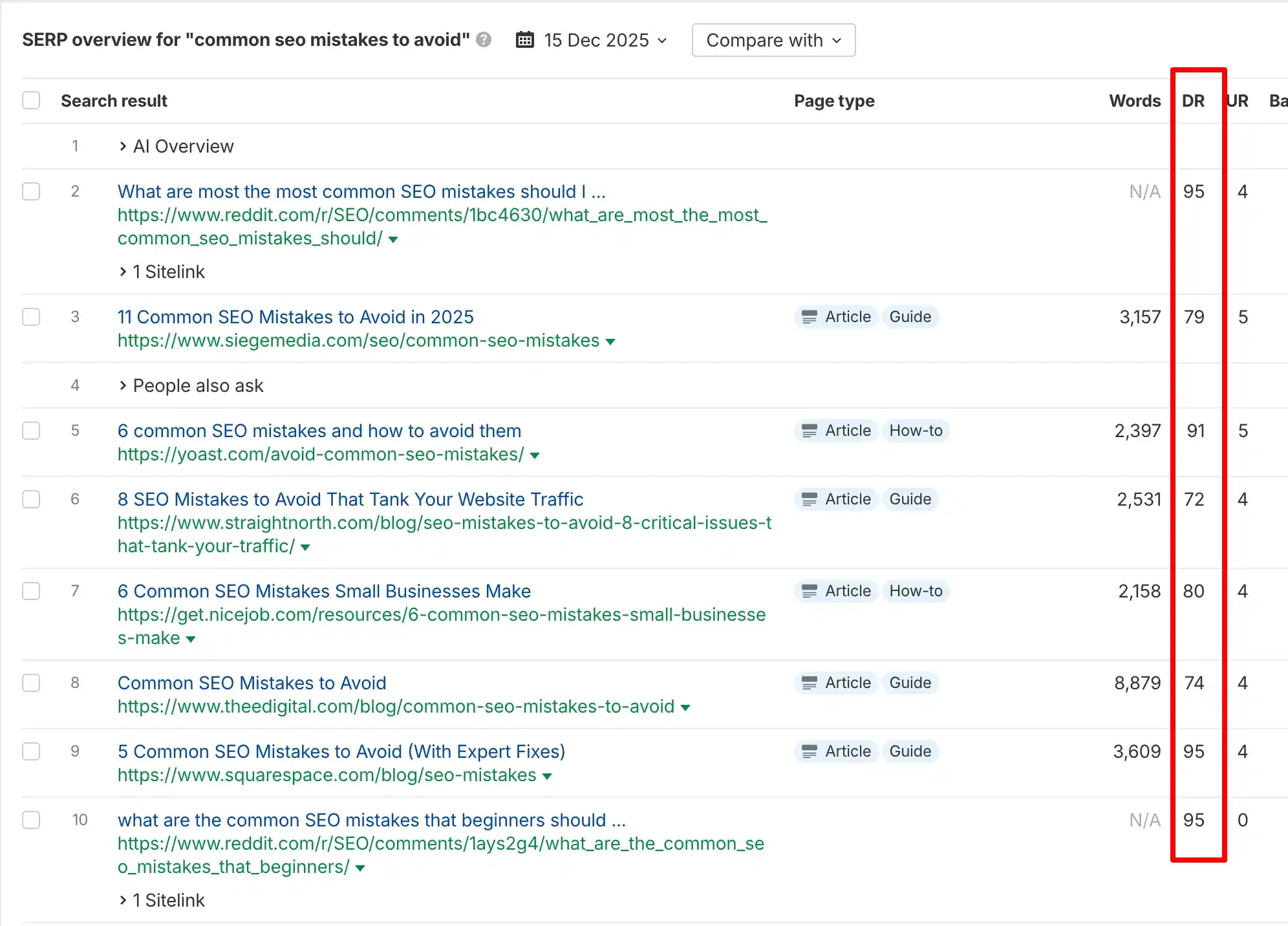
But if we look at the page-level competitors, the competition is crazy.
I’ve seen this so many times. Agencies, freelancers, and even in-house SEO teams filter for “low KD” keywords, build a plan around them, and tell the client something like, “These should be easy wins.”
The client waits a few weeks, maybe a couple of months, expecting to quickly hit the top three. But when you dig into the SERP, you see a very different picture.
Sometimes a keyword shows a low KD, but the top results are strong brands with solid authority, deep content, great internal links, and a lot of trust in the niche.
So don’t fool yourself by thinking “KD 5” means “easy.” If you really want to assess competition, forget such metrics and open the SERP.
Look at the top five or ten pages. Check who is ranking, what their overall site authority looks like, how in-depth their content is, what type of page it is (blog, landing page, tool, directory), and how well they match the intent.
Take notes. Then ask yourself honestly whether you can produce something better and support it with enough links and authority.
Of course, Google is still the main search engine. I’m not saying ignore it. But if your whole SEO strategy is “Google or nothing,” you’re already behind.
Search today is not just ten blue links anymore. You have AI overviews, YouTube, forums, social media search, and AI platforms like ChatGPT, Perplexity, and all the other LLMs people use to make decisions.
Your potential clients are not only “Googling.” They’re watching YouTube breakdowns, scrolling Reddit threads, checking LinkedIn posts, and even asking AI tools who they should work with.
If you’re only optimizing for classic Google rankings, you’re leaving a lot of opportunity on the table. The way I see it, all these platforms are different doors to the same room: your brand.
You must appear in as many of those places as you reasonably can.
I already have a separate guide on how to audit your SEO for LLMs, and honestly, once you start thinking that way, you realize how many signals live outside traditional search.
It’s not just backlinks and technical stuff anymore. It’s your brand mentions, your content across the web, the quality of your answers, the depth of your expertise, and how consistent you are everywhere.
This doesn’t mean you need some crazy “secret hack” for every platform. You don’t have to invent tactics you’ve never tested. Just understand how people use each channel, what type of content works there, and find your own middle ground.
Google is important, yes. But it’s not the only place where people discover you anymore.
I have maybe 15–20 minutes a day to scroll LinkedIn, and even in that short window, I see a ridiculous amount of “SEO wins.” Screenshots everywhere. “Look, 2,000% traffic growth!” “Look, insane results in 30 days!”
In a lot of those posts, the website URL is hidden. Google Search Console screenshots are missing. You never see what keywords drive that traffic, and when you do dig a bit deeper into some competitors or agencies, you often realize the “crazy growth” is:
Is that technically growth? Sure. Is it something to build your expectations and strategy around? No.
This is why blindly believing every SEO success story is a big mistake. Of course, there are real, solid case studies out there. I’m not saying everyone is lying. But a huge portion of what you see is either missing context, heavily decorated, or designed to impress beginners and business owners who don’t know how to read the numbers.
If you constantly compare yourself to those screenshots, you’ll start thinking, “Why can’t I do this? What’s wrong with me? Why are my results slower?” Such a mindset will destroy your motivation and your long-term career.
In this guide on the top 10 SEO mistakes, I didn’t want to repeat the same checklist you see everywhere. Everything you’ve just read comes from real projects, real clients, and the things I keep seeing that honestly drive me crazy in this industry.
If this helped you avoid even a few of these costly mistakes, I’m very happy. That’s what I enjoy doing and what I’m obsessed with getting better at.
If you ever feel stuck and need someone to step in, audit your situation, and build a cleaner, smarter SEO strategy, reach out to Digital World Institute. We might be the team that helps you write your next real success story, without all the nonsense you see in most “SEO advice.”
