


by: SEO Strategist
Ashot Nanayan
Updated December 24, 2025
6 min. read

WhatsApp
 (+1) 818 355 1889
WhatsApp
(+1) 818 355 1889
WhatsApp
(+1) 818 355 1889
WhatsApp
(+1) 818 355 1889
WhatsApp
(+1) 818 355 1889
I’ve worked with a wide range of healthcare providers, from B2B medical device manufacturers to dental clinics and medical imaging brands. But only last year, our team took on something different: a physiotherapy clinic with a limited budget, a clear niche, and one bold goal: rank #1 in their area.
I stayed involved in every corner of the campaign. After a while, we noticed it in the small stuff first: fewer gaps in the schedule, more people saying “I found you on Google and ChatGPT,” and way less anxiety about next month’s bookings.
So I’m putting the playbook on the table. Below are the SEO strategies we used for physiotherapists (Including fails).
If you’d like the same problem; too many good patients, not enough slots, start with this guide and steal whatever fits your clinic.

One of the most reliable strategies we use for physio SEO – regardless of whatever “SEO trend” is going around – is targeting very specific, high-intent long-tail keywords.
In physiotherapy, this works incredibly well because people rarely search just for “physiotherapist”. They search for a problem, a body part, and a location.
For example, queries like “sports physio in Glendale”, “vestibular rehab in Pasadena”, or “dry needling for neck pain in Los Angeles”. These people are not just browsing. They’re usually in pain, they know roughly what they need, and they’re trying to find someone nearby who can help.
So, instead of one generic “Physiotherapy in [City]” page, we build dedicated pages around specific combinations: sports physio, post-surgery rehab, vestibular rehab, pelvic floor physio, dry needling, etc.
On every page, we make sure a few things are always in place. The copy speaks directly to the symptoms and situations you see in the clinic (“recurring ankle sprains from football”, “dizziness when you get out of bed”, “neck pain from desk work”).
We add outcomes you commonly treat and what patients can realistically expect after a few sessions. We include a short, honest FAQ section that answers the questions people ask on the phone: how many sessions they might need, how long an appointment takes, whether they need a referral, what to bring, and so on.
So, instead of fighting for one broad keyword that everyone else is targeting, you quietly build an entire cluster of very targeted, local pages. They’re easier to rank, they convert better, and they match how patients search when they’re ready to book.
Also read: 8 Healthcare SEO Case Studies

When I teach SEO, one of my favorite tasks for students is: forget tools for a moment and write down how people would search in their own words. We do the same thing for physiotherapists.
Patients don’t type “physiotherapy treatment plan” into Google. They type what’s on their mind.
It’s usually something like:
Those searches are messy, emotional, and very human. That’s why they’re awesome.
Instead of only having a generic page like “Physiotherapy in [Country/City]”, we create specific condition pages built around these real-life phrases. For example, a page like:
“Knee Pain Going Down Stairs: Causes, Physio Checks, and Treatment Options”
On that page, we walk through what might be happening, what a physio usually checks in the first session, and which treatment paths are common. We answer the questions that are already in the patient’s head: Do I need a scan? Is this serious? How long until it gets better?
From an SEO point of view, this is several times stronger than a broad, formal page.
When your page mirrors their language and explains their exact situation, it feels like you’re reading their mind. That builds trust before they even call the clinic.
In my healthcare SEO guide, I already explained that GBP is one of your valuable SEO assets. For any local physio clinic, your Google Business Profile is often the first and only thing patients look at before deciding whether to call you or scroll past.
Many clinics with well-designed websites and numerous online mentions still struggle in maps simply because their profiles are half-empty or missing basic details, such as a clear address.
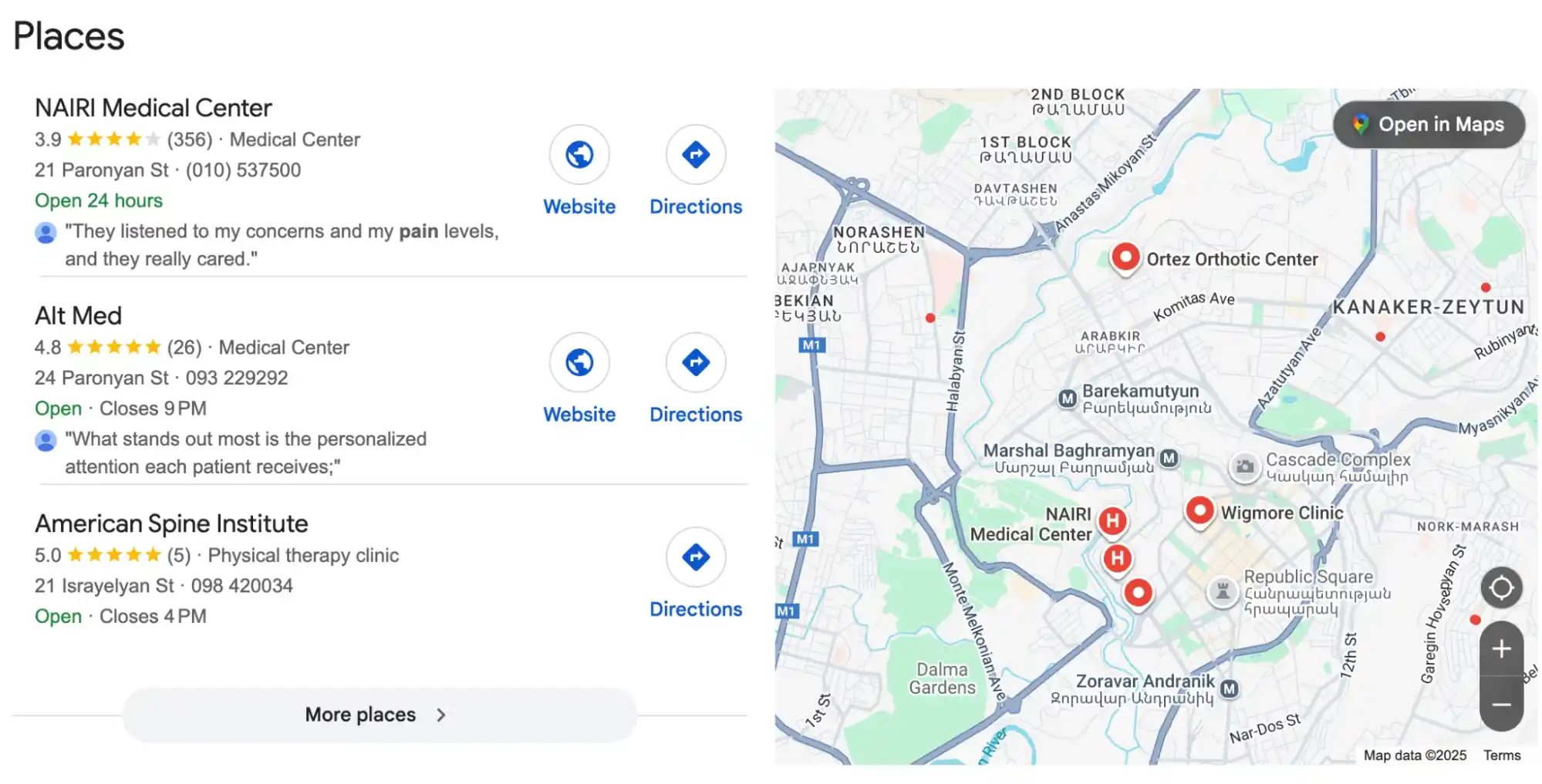
Treat your GBP like a standalone landing page. Start with the basics: a complete, accurate name, address, and phone number that match the information on your website.
Add the right primary category (usually Physiotherapist / Physical Therapist) and then use services and descriptions to quietly cover your other angles: sports physio, post-op rehab, vestibular rehab, dry needling, pelvic floor, whatever you offer.
Finally, keep it alive. Upload real photos monthly: treatment rooms, reception, outside signage, rehab equipment, your team working with patients (respecting privacy, of course).
Ask happy patients to leave reviews and respond to them like a human, not with copy-paste templates. Over time, your Google Business Profile should feel like a mini-website that sells your clinic on its own.
Remember, you should always consider more advanced SEO strategies than your competitors. “We’ve got 4.9 stars on Google, job done.” For SEO and for patients, that’s not enough.
The real value is in what people say, not just how many stars they click. If you’ve been in business for a while and already have a decent reputation, you can turn those reviews into something much more powerful than a badge on your homepage.
One of my favorite approaches is creating a dedicated “Results & Reviews” page and organizing your feedback by problem type.
Instead of putting everything into one long list, you group them into sections like:
Back pain and neck pain
Post-op rehab (ACL, shoulder surgery, hip replacement, etc.)
Sports injuries
Vestibular and dizziness
Pelvic floor and women’s health
Under each section, you can include a mix of short quotes, screenshots, or anonymized stories that speak directly to that problem: how long they were in pain, what changed after a few sessions, and what they can do now that they couldn’t do before.
It helps Google understand that you don’t just claim to treat these conditions – you have real, problem-specific proof.
It also reassures patients who are nervous and skeptical. They’re not just seeing “Great clinic, friendly staff” but reading “I had knee pain after surgery and was back to running in X weeks with this team.”
A few best practices: keep patient details respectful and compliant with privacy rules, keep the formatting clean and easy to scan, and update this page regularly.
Over time, this becomes one of the strongest assets on your site: a living library of proof that backs up every promise you make on your service pages.
As a physio, you already know where most of your patients come from: orthopaedic surgeons, local gyms, sports clubs, workplaces, maybe even specific coaches or personal trainers.
You live this every week, but you might not have translated it into your website structure yet. So here’s another tactic from Digital World Institute: build landing pages specifically for those referral streams.
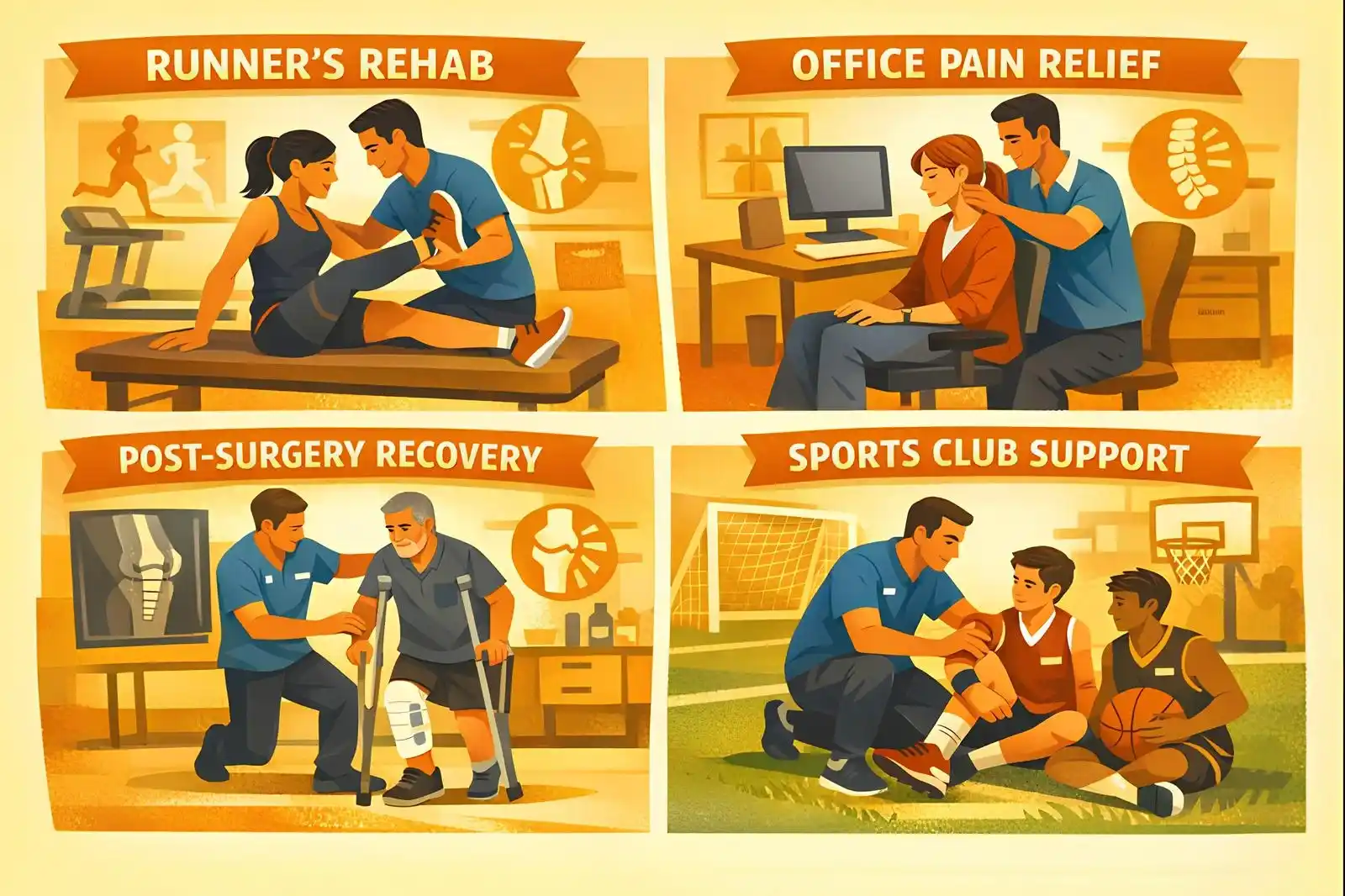
The “physio for runners” page should talk about overuse injuries, race prep, recovery after events, and how you work alongside coaches. The “post-orthopaedic surgery physio” page should explain how you coordinate with surgeons, what the first few weeks look like, and what realistic milestones usually are.
When someone lands there, they should instantly feel, “Okay, this is for me.”
These pages naturally align with high-intent, local searches and give you more entry points into your clinic than just a generic “Physiotherapy in [City]” page.
I’m going to share a physiotherapy SEO tip we used for one of our clients that you don’t usually see in generic “SEO checklists”, but it worked incredibly well. Believe me, it’s very simple: build strong “First Visit” and “Pricing & Insurance” pages and treat them as high-intent landing pages, not just boring policy pages.
Before someone books, they almost always want to know two things:
Those questions are pure intent. If someone is searching “physio prices in [city]”, “is physio covered by [insurance name]”, or “what to expect at first physio visit”, they are not at the “just researching” stage anymore.
They’re trying to decide whether to call you or not.
A “Pricing & Insurance” page: clear session fees, package options (if any), how insurance claims work, which insurers you work with, what self-pay looks like, and what happens if someone is out-of-network. Again, we added real questions people ask on the phone and answered them in plain language.
Within a few months, our client’s “ Pricing & Insurance ” page became one of the top landing pages for local searches and generated more bookings than several blog posts combined.
It ranked for a mix of “[clinic] prices”, “[city] physio cost”, and “[insurance] physiotherapy coverage”.
The takeaway: don’t bury this information in a small footer link. Give “First Visit” and “Pricing & Insurance” their own space, optimize them like landing pages, and connect them to your key service pages.
In the healthcare industry, backlinks matter a lot more than you think. It’s not enough to publish “5 exercises for knee pain” and hope some big site links to you. If you want HQ links from reputable websites, universities, or professional blogs, you need proper linkable assets; content that stands out from generic health advice.
For physio clinics, one of the best angles I’ve seen is building test-focused content clusters around how you assess patients. Here are some examples:
Now, here’s where the “dual” part comes in. You can have:
Patient-friendly pages that explain these tests in simple words: what the test is for, what the patient will feel, what it helps rule in or rule out, when you might refer out, and what happens afterwards.
Clinician-level or student-friendly explainers that go a bit deeper: variations of the test, sensitivity/specificity (without turning it into a textbook), common mistakes, and how it fits into a broader assessment.
Also read: Dental SEO: #1 Playbook for Beginners

A few best practices: don’t copy textbook language; explain things as you would to a curious patient. Add simple diagrams or photos when possible. Include internal links from your condition pages to these test pages (“In your first session for suspected ACL issues, we may perform tests like the Lachman and pivot shift – learn more here.”).
Over time, this gives you two wins, I promise: stronger topical authority in the eyes of Google and a handful of link-worthy assets that most physio competitors in your city don’t have.
At our healthcare SEO agency, we understood a while ago that AI search is becoming the front door. If you’re invisible in AI search engines like ChatGPT, AI Overviews, Gemini, Perplexity, and other LLMs, you’re already behind, even if your “classic” SEO looks great.
For physiotherapists, this is more important than it seems. When someone types “best physio for runners in [city]” or “who is good for vestibular rehab near me” into an AI search engine, those systems look for strong brands, clear expertise, and content that is easy to understand, cite, and summarize.

I’ve already put together a full guide on how to audit your website for LLMs, including a detailed checklist you can go through step by step. You can check that out if you want to go deeper into the technical side and see how your current content stacks up.
If you’d rather have someone do this for you, we also offer AI-focused SEO services. If you’re curious where you stand and what it would take to appear in an AI search for your niche, reach out, and we can send over a quick, no-drama proposal.
When I first got into the SEO world (Over seven years ago), I honestly thought link building was “copy–paste” across every industry. Same tactics, same templates, same targets, just change the niche. It took me a few years (and a lot of testing) to realise how wrong that is, especially for healthcare.
Healthcare sites, including physiotherapy clinics, need backlinks from the right places. A physio clinic getting links from random lifestyle blogs, link farms, or old-school PBNs is not the same as being cited by respected healthcare publications.
Remember, Google can see the difference, and so can your patients. In this space, you really have two or three serious options:
Getting quoted, interviewed, or featured as an expert in stories about pain, movement, injury prevention, workplace ergonomics, sports performance, etc.
HARO-style link building / expert commentary – answering journalist requests and becoming the “go-to” physio voice in articles.
You can also support this with linkable assets like the test-based content and in-depth guides I talked about earlier.
If you’re ready to invest properly, we can go after mentions and backlinks from real healthcare and wellness publishers like Medical News Today, Verywell Mind, Healthline, and many others.
There are many more angles here, and I’ve broken them down in my linkable assets guide if you want to dive deeper.
Forget generic PBNs and link farms. If you want to build a physiotherapy brand that Google and patients take seriously, aim for relevant, editorial links from real healthcare-related sites.
If you want help with that, you can always reach out and check our healthcare link-building services.
If you’re not familiar with the acronym: E-E-A-T stands for Experience, Expertise, Authoritativeness, and Trustworthiness. In simple words, Google is asking:
“Is this content written by people who know what they’re doing, and can we trust them with someone’s health?”
For physiotherapists, this is huge. You’re not selling T-shirts. You’re dealing with pain, post-surgery rehab, dizziness, and long-term injuries. Generic, copy-paste content doesn’t work in this niche anymore.
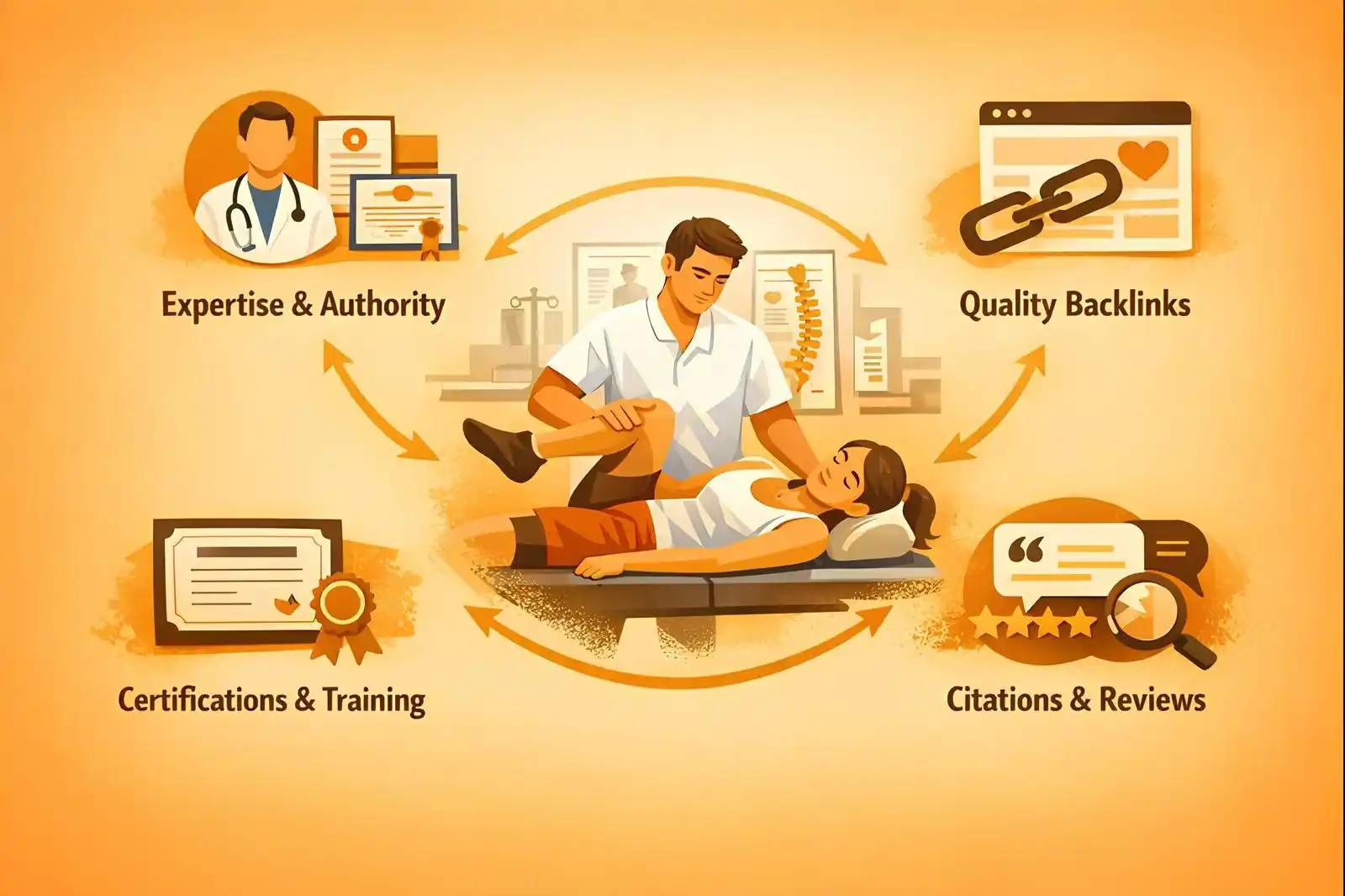
Each key clinical page on your site should feel like it comes from a real clinic with real specialists, not a faceless brand. That means:
Don’t outsource your brain. Hire or collaborate with real experts, even retired clinicians, to help shape and review your content. Let them add nuance, examples, and clear boundaries on what physio can and cannot do.
In a niche like physiotherapy, “good enough” content that could live on any clinic’s website is what holds you back. Google and your patients want to see that you know your craft and can back it up with names, credentials, experience, and proof.
Physiotherapy SEO demands strategic thinking, clinical expertise, and careful execution across your content, local presence, and links. If you’re only looking for generic services or the lowest-cost option, you’ll most likely get generic results.
But if you’re patient, serious about building a reputation, and ready to dominate your local market for the right searches, contact Digital World Institute. We treat physio SEO like a long-term partnership. Reach out, and let’s see how far we can
push your clinic’s growth.
You don’t beat them on volume; you can beat them on relevance and trust. Focus on ultra-specific local pages, strong Google Business Profile, real reviews, and content.
Strictly speaking, no, but it massively helps conversions. If your SEO brings the right people in, a clean, simple online booking flow removes complications and turns far more of those visits into actual appointments.
Start with LocalBusiness / MedicalBusiness for the clinic, add Person schema for clinicians, FAQ schema for key pages, and, where relevant, Article/BlogPosting for in-depth content. Keep it accurate and consistent with what’s on the page.
Tidy up your Google Business Profile, add clear CTAs and phone/booking buttons above the fold, simplify your contact/booking forms, and make sure key trust elements: reviews, bios, pricing/insurance info, are easy to see without scrolling forever.
